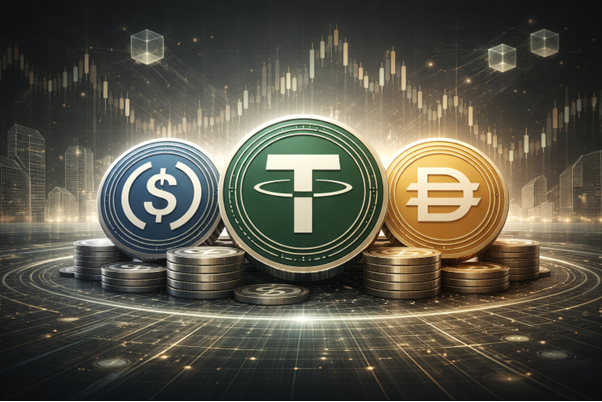
Stablecoins nowadays are pretty much an integral part of the crypto market and, in a way, a bit of an infrastructure layer.
A few years ago, people for the most part still saw them as temporary safe havens during volatile periods, however by 2026, they have come to be known as core trading tools, instruments for capital preservation, and a way of transferring value across different platforms.
There are tens of other stablecoins besides these three, which have remained at the top both in terms of usage and discussions: USDT (Tether), USDC and DAI. Each one represents a different design philosophy and caters to a different investor segment. This article contrasts these leading stablecoins and investigates which one investors really prefer in 2026 — and under what circumstances.
Why Stablecoin Choice Matters More in 2026
The crypto market has matured significantly over recent years. Greater regulatory oversight, deeper institutional participation, and expanding global adoption have changed how investors interact with digital assets.
In this environment, choosing a stablecoin is no longer a trivial or purely technical decision. During periods of increased market volatility — especially toward the end of the year, when Bitcoin price movements tend to intensify — speed and flexibility become critical factors for many users, as highlighted in this analysis of why Bitcoin tends to become more volatile toward year-end.
For many participants, stablecoins now function as:
- base assets for trading pairs
- tools for managing risk during market volatility
- bridges between centralized and decentralized platforms
- instruments for transferring value quickly and efficiently
As a result, differences between USDT, USDC, and DAI have become more relevant than ever.
What Investors Expect From a Stablecoin
Despite their differing architectures, most investors expect the same core qualities from any stablecoin they use:
Price Stability
A stablecoin’s primary function is to maintain a consistent value, typically pegged to the US dollar.
Liquidity
High liquidity allows investors to enter and exit positions quickly, even during fast-moving market conditions.
Accessibility
Exchanges, wallets, and DeFi protocols need to be widely supporting each other for real-life applications.
Low Transaction Costs
As on-chain activity increases, network fees play a growing role, especially for frequent transfers.
Trust and Transparency
Confidence in reserve backing, issuance mechanisms, and governance remains essential for long-term adoption.
USDT Overview: Liquidity and Global Adoption
USDT remains the most widely used stablecoin in the crypto market in 2026. Its dominance is driven less by ideology and more by practicality.
Key characteristics of USDT include extensive support across centralized exchanges, availability on multiple blockchain networks, deep liquidity as a base trading pair, and frequent use for rapid capital movement between platforms.
For active traders, USDT often serves as a default settlement asset. Its liquidity enables large positions to be opened or closed efficiently, even during periods of heightened volatility. For many users, the ability to buy usdt with card with ease has further strengthened USDT’s role as a primary entry point into the crypto market.
Beyond trading, USDT is also widely used for transferring funds across platforms, particularly on networks known for faster confirmations and lower transaction fees.
USDC Overview: Regulation and Institutional Appeal
USDC continues to position itself as a compliance-first stablecoin. In 2026, it remains especially popular among institutional participants and regulated platforms.
Strengths of USDC
- frequent reserve attestations and transparency
- strong focus on regulatory alignment
- deep integration with institutional DeFi products
Limitations
- greater exposure to account freezes and blacklisting
- more limited availability in certain regions
- less commonly used for high-frequency trading
USDC is often chosen by investors who prioritize regulatory clarity and transparency over maximum flexibility.
DAI Overview: Decentralization and Trade-Offs
DAI represents a fundamentally different approach to stablecoins. Instead of relying on fiat reserves, it is generated through overcollateralized crypto positions managed by smart contracts.
Advantages of DAI
- decentralized issuance and governance
- censorship resistance
- strong presence within DeFi ecosystems
Challenges
- reliance on collateral stability
- more complex mechanics for non-technical users
- limited adoption outside DeFi-centric use cases
In 2026, DAI remains a preferred option for users who value decentralization, though it is less commonly used for everyday trading or transfers.
USDT vs USDC vs DAI: Key Differences at a Glance
| Feature | USDT | USDC | DAI |
| Peg mechanism | Fiat-backed | Fiat-backed | Crypto-collateralized |
| Liquidity | Very high | High | Moderate |
| Exchange support | Extensive | Broad | Limited |
| DeFi usage | Medium | High | Very high |
| Regulatory exposure | Medium | High | Low |
| Typical use cases | Trading, transfers | Institutional use | DeFi strategies |
This comparison highlights why investor preferences are shaped more by use case than by ideology.
Which Stablecoin Are Investors Going to Actually Use in 2026?
The analysis of the behavior of the market in 2026 has revealed a distinct trend:
- Seasoned traders mostly prefer USDT, especially when trading in volatile markets, as it is the most liquid one and the easiest to move through various exchanges.
- Institutional and compliance-driven investors usually go for USDC because of its well-regulated image and disclosure.
- DeFi-native folks choose DAI, as they focus on decentralization and on-chain governance.
Instead of determining a single stablecoin as the “best”, a good number of investors possess multiple stablecoins that they move in and out of depending on changes in the market and their strategic requirements.
Final Thoughts
The stablecoin environment in 2026 is a mirror to how the overall crypto market has changed. Stability doesn’t mean sameness, and various stablecoins are designed to serve different functions.
USDT keeps on being the leader regarding liquidity and overall usability, especially in high-speed trading. USDC is suitable for regulated and institutional situations, whereas DAI is still a fundamental element of decentralized finance.
The main point for investors is straightforward: it is not a matter of ideology but rather strategy when it comes to picking up a stablecoin. Knowing when and why each alternative is appropriate for a particular use case is now an integral part of moving through the crypto world.